

Why SEO Isn’t Enough Anymore, And Why That’s a Good Thing
For years, many businesses have followed a straightforward approach to online growth: improve their website, target the right keywords, build backlinks and try to rank higher on Google. If the website attracted more visitors, the strategy seemed to be working.
SEO still plays a major role in helping people discover businesses online. But the way people search, compare options and decide what to buy is changing. They might find a brand through Google, watch a product review on YouTube, discover a business on Instagram, read customer reviews or ask an AI-powered search tool for recommendations.
This creates a new challenge for businesses that rely entirely on organic search traffic.
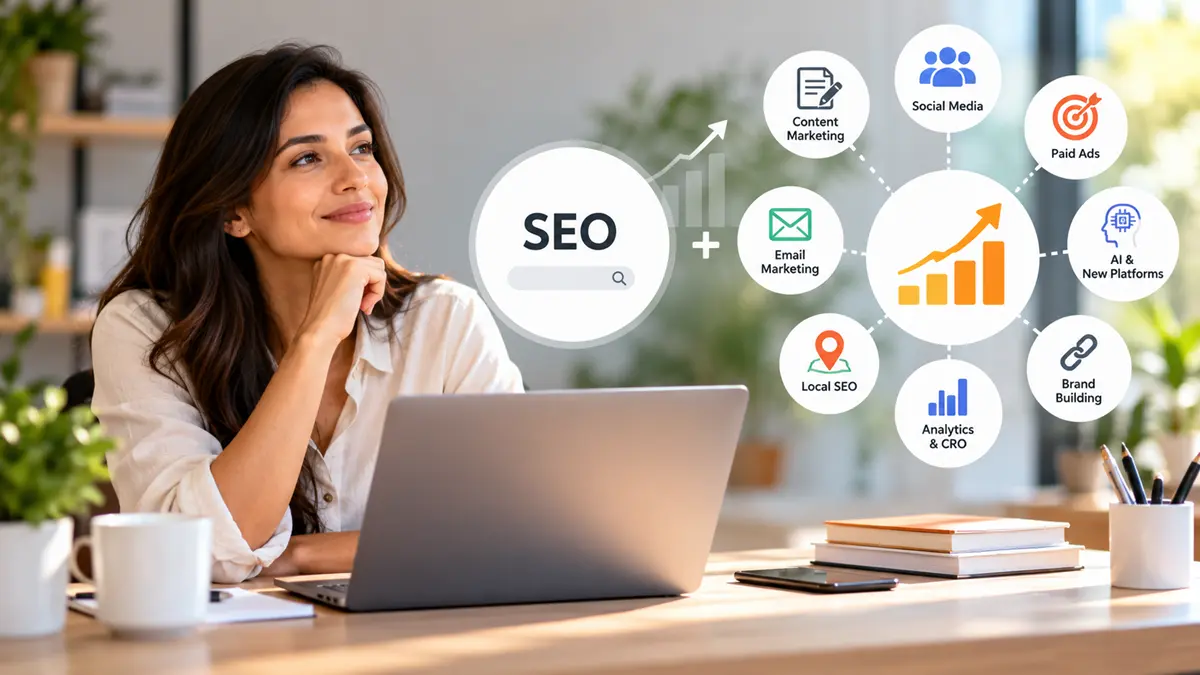
SEO is not becoming irrelevant. It is becoming one part of a much bigger picture. Businesses that combine SEO with useful content, social media, paid advertising, email marketing and a good customer experience have more ways to reach potential customers.
The good news? You do not need to invest in every marketing channel at once. You need to understand how your customers find information and build a strategy around their behaviour.
1. SEO Still Matters, But Customer Behaviour Has Changed
Search engine optimisation helps search engines understand your website and helps potential customers find relevant information. It includes activities such as keyword research, technical optimisation, content creation, internal linking and improving the overall website experience.
These activities remain valuable. A well-optimised website can attract people who are actively looking for a product or service.
The difference is that Google is no longer the only place where people discover businesses.
Consider someone looking for a reliable digital marketing agency. They might begin with a Google search, visit two agency websites, check LinkedIn profiles, watch a marketing video and read reviews before contacting anyone.
Another person might discover an agency through a LinkedIn post and visit its website directly.
Both people could become customers, but their journeys are different.
This is why businesses should avoid measuring their entire online presence through Google rankings alone. Rankings are useful, but they do not show every way people discover or evaluate a business.
2. AI Search Is Changing How People Find Information
One of the biggest changes in online discovery is the growth of AI-powered search experiences.
People can now ask detailed questions and receive summarised answers that draw on information from multiple sources. Google AI Overviews and AI Mode are examples of how this experience is becoming part of search.
Instead of searching for several separate terms, a user might ask:
-
Which digital marketing agency is suitable for a small ecommerce business?
-
How much should a small business spend on SEO?
-
What should I check before hiring a local SEO specialist?
-
Which marketing channels work best for a business with a limited budget?
AI-powered search can help users explore these questions without opening every result on the search page.
For website owners, this creates both an opportunity and a challenge. A business may become visible through a link in an AI-generated answer, but some users may find enough information in the answer itself and never visit the website.
This means a high ranking or a large number of impressions does not automatically translate into more website visits or enquiries.
Does this mean you need a separate AI SEO strategy?
Not necessarily.
Google’s official guidance explains that established SEO practices remain relevant to its AI search features. Websites still need accessible pages, helpful content, clear internal links and information that can be understood by search systems.
The better approach is to create content that genuinely answers customers’ questions rather than chasing every new term associated with AI search.
For example, a web design company could publish a detailed guide explaining what affects website development costs, what a typical project includes and which expenses businesses should plan for.
The article should provide useful explanations, realistic examples and clear limitations. It should not simply repeat the same general advice available on dozens of other websites.
Google’s guidance on AI features and websites is a useful starting point.
3. Ranking on Google Does Not Guarantee More Customers
Getting more organic traffic sounds like a positive result, but traffic alone does not tell the whole story.
Imagine a local plumbing company ranking well for a broad informational keyword. The page attracts hundreds of visitors who want to learn how plumbing systems work, but very few are looking to hire a plumber.
Meanwhile, a service page targeting people searching for emergency plumbing in the company’s actual service area may attract fewer visitors but generate more relevant enquiries.
This is a simple example of why the quality of traffic matters as much as its quantity.
A business should ask three questions:
-
Are we attracting the right people?
-
Are visitors taking meaningful actions on our website?
-
Are those actions contributing to enquiries, sales or other business goals?
If a page receives traffic but produces few enquiries, investigate the problem before spending more money trying to improve its ranking.
The page might target the wrong audience, lack clear pricing information, have a confusing contact form or fail to explain why someone should choose the business.
Sometimes, the solution is better SEO. In other cases, the business needs stronger messaging, a better landing page or a simpler way for visitors to get in touch.
4. Social Media Gives Businesses Another Way to Get Discovered
Social media is useful for more than likes and followers. It can introduce a business to people who may not be actively searching for its products or services.
Google search often captures existing demand. Social media can help create awareness before someone knows exactly what they need.
For example, a dental clinic might publish a short video explaining why gums bleed during brushing. Someone watching the video may recognise the problem and decide to book a dental appointment.
Similarly, a clothing brand could use Instagram to demonstrate how to style a particular product. A viewer who was not searching for that product might become interested after seeing it in use.
The key is to match the content to the audience and the platform.
How businesses can use social media effectively
-
Share practical advice: Answer questions customers commonly ask.
-
Show products or services in context: Help people understand how an offering fits into their lives or solves a problem.
-
Demonstrate expertise: Explain processes, common mistakes and important considerations.
-
Build trust: Share genuine customer feedback with permission and respond professionally to questions.
-
Give people a next step: Direct interested users to a relevant service page, product page or enquiry form.
A business does not need to publish on every social platform. It should start with the channels its potential customers use and maintain a realistic posting schedule.
Social media also has limitations. Reach can fluctuate, audiences may not match the target market, and followers do not necessarily become customers. Treat it as a way to support discovery and relationships, not as a guaranteed source of sales.
5. Content Marketing Helps You Reach People at Different Stages
A potential customer rarely makes every decision after reading one webpage.
Someone might first learn about a problem, compare possible solutions, evaluate suppliers and finally decide whether to make a purchase.
Content marketing helps businesses provide useful information throughout this process.
A strong content strategy includes more than publishing blog posts to target keywords. It considers what people need to know before they are ready to contact or buy from a business.
For example, a company selling accounting software could create:
-
Beginner guides explaining common accounting problems.
-
Comparison articles covering different software options.
-
Tutorials demonstrating how specific features work.
-
Pricing explanations that help customers understand the available plans.
-
Frequently asked questions addressing common concerns.
Each piece serves a different purpose.
A beginner guide may introduce the company to a new audience. A comparison article may help someone shortlist providers. A pricing page may help a potential customer decide whether the product fits their budget.
Create content that answers real questions
Start by collecting questions from sales calls, customer emails, support requests and conversations with your team.
Look at what people ask before they buy, what confuses them and what stops them from moving forward.
Then create content that answers those questions clearly.
Do not publish an article simply because a keyword has search volume. Ask whether the topic is relevant to your audience and whether you can provide something useful.
This approach also supports SEO because helpful, original content gives visitors a reason to engage with your website.
6. Paid Advertising Can Support Organic Marketing
SEO can take time to produce meaningful results. Even an excellent website may need months of consistent work before it attracts a reliable flow of organic traffic.
Paid advertising offers another way to reach potential customers.
Google Ads can help businesses appear for relevant searches, while social advertising can introduce products and services to selected audiences. The right choice depends on the business model, audience and campaign objective.
Consider a new ecommerce store selling home accessories. Its SEO strategy may focus on product category pages, buying guides and technical improvements. At the same time, a small paid campaign could test which products and messages attract qualified visitors.
The advertising results may help the business identify promising products, common customer objections and effective landing pages. These findings can inform future content and website improvements.
However, paid advertising is not a substitute for a weak website or an unclear offer.
Before launching a campaign, check that:
-
The landing page matches the advertisement.
-
The product or service is explained clearly.
-
Prices, delivery details or service areas are easy to find.
-
The website works properly on mobile devices.
-
Enquiries and purchases are tracked correctly.
-
The budget and acceptable acquisition cost are understood.
Start with a manageable budget, measure the results and make decisions based on evidence. More advertising spend does not automatically mean more profitable sales.
7. Email Marketing Helps You Stay Connected With Potential Customers
Not every visitor is ready to buy during their first website visit.
Someone researching an expensive service may need several weeks to compare providers. An online shopper might leave without purchasing because they are not ready to make a decision.
Email marketing gives businesses a way to maintain contact with people who have voluntarily subscribed or requested further information.
For example, a business consultancy could offer a useful checklist in exchange for an email subscription. It could then send relevant advice, explain common mistakes and share information about its services when appropriate.
An ecommerce business might send product updates, buying guides or useful information about an upcoming purchase.
The purpose is to build a useful relationship, not to send constant promotional messages.
A practical email strategy should include:
-
A clear reason for someone to subscribe.
-
Relevant content based on the subscriber’s interests.
-
A manageable sending schedule.
-
Clear unsubscribe options.
-
Appropriate consent and compliance with applicable privacy and marketing laws.
Email marketing is particularly useful because it can help businesses communicate with an existing audience without depending entirely on search rankings or social platform reach.
It still requires effort. An email list is only valuable when subscribers receive information they want and trust the sender.
8. Your Website Must Turn Attention Into Action
Businesses sometimes focus so heavily on getting visitors that they overlook what happens after someone arrives.
A website may rank well, receive social media referrals and attract paid traffic, yet generate very few enquiries.
The problem may be the experience visitors have on the website.
Think about what a potential customer wants to know. Can they understand what you offer within a few seconds? Can they find the relevant service, check important details and contact you without unnecessary effort?
If not, additional traffic may not solve the problem.
Review these areas first
Clear messaging: Explain what you offer, who it is for and what problem it solves.
Useful service pages: Provide enough detail for visitors to understand the service, process, expected deliverables and relevant limitations.
Trust signals: Make genuine business information, contact details, relevant credentials and authentic reviews easy to find.
Mobile experience: Check whether the website is easy to navigate on a phone. Forms, buttons and important information should remain accessible.
Page speed and functionality: Fix broken links, confusing navigation and technical issues that prevent visitors from completing actions.
Clear calls to action: Make it obvious how someone can request a quote, book an appointment, ask a question or make a purchase.
For example, a local service business could receive 1,000 monthly visitors but only a handful of enquiries. Instead of immediately trying to double traffic, it should first examine which pages attract visitors, whether the service information is clear and where users abandon the enquiry process.
The figures in this example are illustrative, not a benchmark. The right conversion rate depends on the industry, audience and type of action being measured.
9. Local Businesses Need More Than Website Rankings
For local businesses, online discovery often involves several sources of information.
A potential customer may search Google Maps, read reviews, check business hours, visit the website and compare nearby providers before making contact.
A business that concentrates only on traditional website rankings may overlook these other opportunities.
Local SEO remains essential, but it should support a broader local presence.
Practical actions include:
-
Keeping Google Business Profile information accurate and up to date.
-
Ensuring the business name, address, phone number and opening hours are correct wherever they appear.
-
Publishing useful information about services and service areas.
-
Encouraging genuine customer reviews without offering inappropriate incentives.
-
Responding professionally to customer feedback.
-
Creating helpful local service pages where they genuinely serve a customer need.
-
Making contact details, directions and booking options easy to access.
A hypothetical dental clinic, for instance, could improve its local visibility through an accurate Business Profile, useful treatment pages, clear appointment information and genuine patient feedback.
It could also publish educational content on social media and maintain a website that helps visitors understand available treatments.
These activities support different stages of the customer’s decision. None guarantees a particular ranking, but together they provide more ways for people to discover and evaluate the business.
10. Measuring Digital Marketing Beyond Rankings
If SEO is one part of a broader strategy, measurement needs to reflect the bigger picture.
Keyword positions and organic sessions remain useful metrics. However, they should be considered alongside actions that matter to the business.
Useful measurements include:
| Channel | What to measure |
|---|---|
| Organic search | Relevant organic traffic, search visibility and conversions |
| Paid advertising | Spend, qualified leads, conversion cost and revenue where measurable |
| Social media | Relevant reach, engagement, referral visits and enquiries |
| Email marketing | Clicks, conversions, unsubscribes and revenue where measurable |
| Website | Form submissions, calls, purchases and conversion rate |
| Local marketing | Business Profile interactions, calls, direction requests and relevant enquiries |
Use tools such as Google Search Console to review search performance and Google Analytics 4 to analyse website activity, provided the relevant tracking is configured correctly.
Advertising platforms can provide campaign data, while a CRM can help connect enquiries with sales outcomes.
Avoid adding every available metric to a report. Choose the measures that help you make decisions.
For example, a local service company may care more about qualified enquiries and booked appointments than social media impressions. An ecommerce store may focus on profitable purchases, average order value and customer acquisition costs.
It is also important to understand attribution. A customer may discover a business through a blog, return through a branded Google search and finally purchase after clicking an email. Different reporting tools may assign credit differently.
Do not assume that the last channel a customer used was the only channel that influenced the decision.
11. How to Build a Broader Digital Marketing Strategy Without Overspending
Expanding beyond SEO does not mean hiring specialists for every channel or launching five campaigns at once.
A sensible approach starts with the business’s existing strengths, customer behaviour and available resources.
Step 1: Understand how customers find you
Review analytics, enquiry forms, customer conversations and sales records. Identify the sources that currently bring relevant visitors and customers.
If you do not have enough data, ask new customers how they first heard about the business.
Step 2: Fix the basics
Before adding new channels, make sure the website is accessible, important pages are useful, contact information is accurate and conversions are being tracked.
A poorly functioning website can waste the opportunity created by almost any marketing channel.
Step 3: Choose one additional channel
Select the channel that best fits your audience and objective.
For a local service business, improving its Google Business Profile and requesting genuine customer feedback may be a sensible next step.
For an ecommerce brand, product-focused social content or a carefully measured paid campaign may be more appropriate.
For a business with a long sales cycle, educational content and email marketing could help potential customers evaluate its services.
Step 4: Set a clear goal
Define what success means before starting.
Examples include increasing qualified enquiries, improving the conversion rate of a service page, generating sales from a particular product category or growing an engaged email list.
Give the activity enough time to produce useful evidence, while setting sensible review points.
Step 5: Review the results and adjust
Compare performance against the original goal. Look at cost, lead quality, sales outcomes and the effort required to maintain the channel.
Continue activities that contribute to meaningful results. Improve or stop those that consume resources without providing enough value.
This approach is more manageable than trying to maintain every marketing platform simply because competitors use it.
12. Common Mistakes Businesses Should Avoid
A broader digital marketing strategy can create new opportunities, but only when the channels work towards a clear objective.
Watch out for these common mistakes:
-
Abandoning SEO too early: SEO still supports discovery, website structure and content visibility, including within AI-powered search experiences.
-
Trying to be everywhere: Managing too many platforms can spread a small team too thin.
-
Chasing vanity metrics: Followers, impressions and traffic are not the same as qualified enquiries or profitable sales.
-
Publishing content without a purpose: Every article, video or post should serve a clear audience need.
-
Running ads without proper tracking: Without reliable conversion data, it becomes difficult to judge whether advertising is worthwhile.
-
Ignoring the website experience: More visitors will not solve unclear messaging, broken forms or weak service pages.
-
Expecting instant results: Different channels work on different timelines, and outcomes depend on competition, budget, offer quality and execution.
-
Failing to follow up: Slow responses to enquiries can waste the attention generated by marketing.
The aim is not to replace one narrow strategy with an unnecessarily complicated one. It is to build a balanced approach that reflects how customers actually discover, evaluate and choose businesses.
Frequently Asked Questions
1. Is SEO still worth investing in?
Yes. SEO helps people discover relevant website content through search engines and can support long-term visibility. It works best when connected to useful content, a good website experience and clear business goals.
2. What should businesses focus on besides SEO?
The right mix depends on the audience and business model. Common options include content marketing, social media, paid advertising, email marketing, local SEO and conversion rate optimisation. Start with the channels most likely to support your immediate business goals.
3. Will AI search replace traditional SEO?
There is no reliable basis for assuming that traditional SEO will disappear. AI-powered search changes how some results are presented, but Google continues to rely on established search systems and SEO fundamentals. Businesses should adapt while maintaining a strong website and helpful content.
4. How can a small business market itself with a limited budget?
Start by improving your website, local presence and existing content. Choose one additional channel, measure relevant enquiries or sales, and expand only when the results justify the extra investment. Consistency and relevance are more useful than trying to do everything at once.
5. How long does it take to see results from a broader digital marketing strategy?
There is no fixed timeline. Paid campaigns may generate traffic quickly, while SEO, content marketing and audience-building activities often require sustained effort. Track early indicators and meaningful business outcomes separately so you can understand what is improving and what needs adjustment.
Conclusion: SEO Is Still the Foundation, Not the Entire Strategy
SEO remains a valuable way for businesses to reach people who are actively looking for information, products and services. But relying on search rankings alone can leave gaps in how a business attracts attention, builds trust and converts potential customers.
A stronger approach combines SEO with the channels that make sense for the business. Useful content can answer questions, social media can introduce a brand to new audiences, paid advertising can test demand, email marketing can maintain relationships and a well-designed website can turn interest into action.
You do not need to do everything at once. Start by understanding your customers, fixing the gaps in your current marketing and choosing one additional opportunity to test.
The goal is not simply to get more people to visit your website. It is to help the right people discover your business, trust what you offer and take the next step.